From science fiction to a new model every few weeks
The History of AI: A Timeline from Asimov to 2026
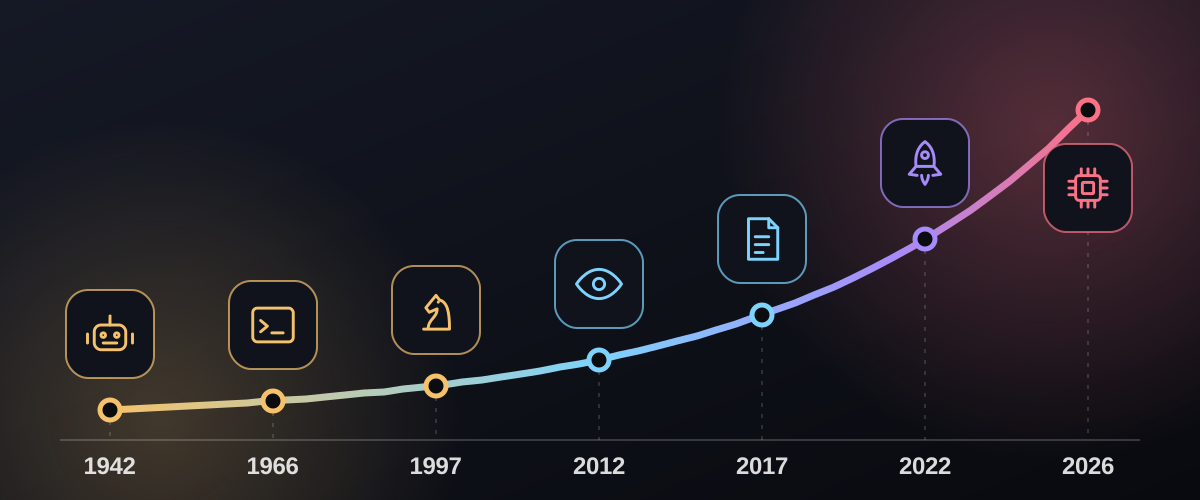
AI did not appear from nowhere in 2022. This is the story in order: eighty years of ideas, false starts and quiet progress, then a few years in which everything happened at once.
Scroll through the five eras below, or jump to one. The models released each year are listed as you go, with a full list by company and an explanation of why progress has been so fast at the end.
1942 to 1997
The idea of a thinking machine
Long before the hardware existed, writers and mathematicians were asking what a thinking machine would be and how we would live with one.
1942
Asimov writes the Three Laws of Robotics
Isaac Asimov's short story "Runaround" sets out three rules to keep robots safe around people. The stories were collected as I, Robot in 1950, and the question they ask, how do you make a machine behave, is the one AI safety teams still work on today.
1950
Turing asks "Can machines think?"
Alan Turing's paper proposes the imitation game: if you cannot tell a machine from a person in a written conversation, does the difference matter? It became known as the Turing test.
1956
The name "artificial intelligence"
John McCarthy coins the term for a summer workshop at Dartmouth College in the United States. The organisers hoped to make real progress in two months. It took rather longer.
1958
The Perceptron
Frank Rosenblatt builds a machine that learns to recognise simple patterns by adjusting its own connections. It is the ancestor of every neural network in use now.
1966
ELIZA, the first chatbot
Joseph Weizenbaum at MIT writes a program that plays a therapist by turning your statements back into questions. It understood nothing, yet people confided in it. Believing a machine understands you is still called the ELIZA effect.
1970s and 1980s
The AI winters
Big promises, slow computers and disappointing results led funders to pull out, twice. "Expert systems" built from hand-written rules had a brief boom in the 1980s and then stalled.
1986
Backpropagation
Rumelhart, Hinton and Williams show how to train neural networks with many layers. The method works, but the computers of the day are far too slow to make much of it.
1997
IBM's Deep Blue beats the world chess champion
Deep Blue defeats Garry Kasparov over six games. It won by brute force, checking around 200 million positions a second, and could do nothing else. A landmark, but not learning as we mean it now.
1998 to 2016
Quiet AI: the algorithms you never noticed
For twenty years AI worked behind the scenes. Nobody called it AI. It was just the search box, the feed and the red underline.
1998
Google and ranked search
Google launches with PageRank, an algorithm that orders the web by how pages link to one another. Search engines soon add machine learning on top.
Early 2000s
Spam filters and "you may also like"
Email providers train filters on millions of messages to spot junk. Amazon's recommendations, and later the $1 million Netflix Prize of 2006, show that predicting what people want is big business.
2006
The social media feed
Facebook launches News Feed and later ranks it by what it predicts you will react to. Instagram, YouTube and TikTok follow. By the mid 2010s, algorithms decide much of what billions of people see each day.
2009
Grammarly
Grammarly starts as a grammar checker for students and grows into a writing assistant used by millions. It is an early example of AI as a helper sitting beside you while you work.
2011
IBM Watson wins Jeopardy!
Watson beats the two greatest champions of the American quiz show by answering questions put in ordinary language. IBM's second headline moment after Deep Blue.
2011 to 2014
Siri and Alexa
Apple puts a voice assistant in the iPhone in 2011 and Amazon puts one in the kitchen with the Echo in 2014. They could set timers and play music, and not much more, but talking to a computer became normal.
2012 to 2021
The real start: deep learning, OpenAI and Anthropic
Three things arrived together: huge amounts of data, graphics chips fast enough to train on it, and one new design, the transformer. Most of what followed was built before Covid, out of public view.
2012
AlexNet: the deep learning breakthrough
A neural network from Geoffrey Hinton's lab in Toronto wins the ImageNet picture-recognition contest by a wide margin. It was trained on two Nvidia gaming graphics cards, which is how Nvidia's chips became the engine of AI.
2014
Google buys DeepMind
Google pays a reported £400 million for the London lab founded in 2010 by Demis Hassabis, Shane Legg and Mustafa Suleyman.
2015
OpenAI is founded
Sam Altman, Elon Musk, Greg Brockman, Ilya Sutskever and others set up OpenAI in December as a non-profit research lab, with $1 billion pledged, to make sure advanced AI benefits everyone.
2016
AlphaGo beats Lee Sedol
DeepMind's system defeats one of the world's best Go players 4 to 1, a decade earlier than most experts expected. Unlike Deep Blue, it learned much of its skill by playing against itself.
2017
"Attention Is All You Need"
Eight Google researchers publish the transformer, a design that lets a model weigh every word in a passage against every other word. It is the T in GPT and the basis of nearly every model on this page.
2018
The first GPT
OpenAI releases GPT-1 with 117 million parameters, the adjustable numbers a model learns. Google releases BERT, which quietly improves Google Search.
GPT-1
BERT
2019
GPT-2 and the Microsoft deal
GPT-2 writes text convincing enough that OpenAI at first holds back the full version. OpenAI creates a capped-profit arm and Microsoft invests $1 billion. This is the year, just before Covid, that the modern race really begins.
GPT-2
2020
GPT-3 and AlphaFold 2
GPT-3 has 175 billion parameters, over 100 times more than GPT-2, and can write essays, emails and code from a short instruction. DeepMind's AlphaFold 2 solves the 50-year-old problem of predicting the shape of proteins.
GPT-3
AlphaFold 2
2021
Anthropic is founded
Seven former OpenAI staff, led by siblings Dario and Daniela Amodei, start Anthropic with a focus on AI safety. In the same year OpenAI shows DALL·E, which draws pictures from a description, and GitHub Copilot starts writing code.
DALL·E
Codex
2022 to 2024
The boom: AI goes public
In November 2022 anyone with a web browser could suddenly talk to a capable AI. Every large technology company changed its plans within months.
2022
AI learns to draw
DALL·E 2, Midjourney and Stable Diffusion arrive within five months of each other and turn a sentence into a picture.
DALL·E 2
Midjourney
Stable Diffusion
November 2022
ChatGPT
OpenAI launches ChatGPT on 30 November as a free research preview. It reaches a million users in five days and an estimated 100 million in two months, the fastest-growing consumer app there had been.
GPT-3.5
2023
The year of the chatbot
GPT-4 and the first Claude appear on the same day, 14 March. Google launches Bard, Meta releases Llama as an open model, and Microsoft puts Copilot into Office. In November the UK hosts the first AI Safety Summit at Bletchley Park, and December brings Google's Gemini.
GPT-4
Claude 1
Claude 2
Bard
Llama 2
Gemini 1.0
Grok 1
Mistral 7B
2024
Voices, reasoning and two Nobel Prizes
GPT-4o talks and sees in real time. Claude 3.5 Sonnet becomes a favourite of programmers and, in October, learns to operate a computer. OpenAI's o1 "thinks" before answering. The EU AI Act comes into force, and Nobel Prizes go to Geoffrey Hinton and John Hopfield (physics) and to Demis Hassabis and John Jumper (chemistry, for AlphaFold).
Claude 3 Opus, Sonnet, Haiku
GPT-4o
Claude 3.5 Sonnet
Gemini 1.5
Llama 3
o1
Gemini 2.0
Sora preview
2025 to 2026
Agents and the compute race
Models stop just answering questions and start doing the work: writing software, researching for hours and using tools on their own. The limit becomes chips and electricity.
January 2025
DeepSeek shocks the market
A Chinese lab releases DeepSeek R1, a reasoning model said to be built for a fraction of the usual cost. Nvidia's shares fall 17% in a day. In the same month OpenAI and partners announce Stargate, a plan to spend up to $500 billion on data centres.
DeepSeek R1
2025
AI that does the job
Coding agents such as Claude Code and OpenAI's Codex work on a task for hours with little supervision. OpenAI releases GPT-5 in August, Google's Gemini 3 arrives in November, and Nvidia becomes the first company valued at $5 trillion.
Claude 3.7 Sonnet
Gemini 2.5 Pro
o3
Llama 4
Claude Opus 4 and Sonnet 4
Grok 4
GPT-5
Claude Sonnet 4.5
Sora 2
Gemini 3
Claude Opus 4.5
GPT-5.2
2026
A new model every few weeks
Releases now come so fast that version numbers blur. Anthropic moves from Claude Opus 4.6 in February to the Claude 5 family in the summer, including the new Fable and Mythos tier. OpenAI goes from GPT-5.4 to GPT-6 in September. Google launches Gemini 4 in the autumn, and Meta's new lab releases Muse Spark.
Claude Opus 4.6
Gemini 3.1 Pro
GPT-5.4
Claude Opus 4.7
GPT-5.5
DeepSeek V4
Muse Spark
Claude Fable 5 and Mythos 5
Claude Sonnet 5
GPT-5.6
Claude Opus 5
Grok 4.5
GPT-6
Claude Opus 5.5
Gemini 4
Mistral Large 4
Claude Fable 5.2
GPT-6.2
Why it got so good, so fast: performance and compute
The ideas behind today's AI are decades old. What changed is scale. Every year the leading labs train bigger models on more data with far more computing power ("compute"), and so far each jump in compute has bought a jump in ability.
5×more computing power each yearThe computing power used to train the leading models has grown about five times a year since 2020. Five years at that rate is roughly 3,000 times more.
1,500×more parameters in two yearsGPT-1 (2018) had 117 million parameters and GPT-3 (2020) had 175 billion. Parameters are the adjustable numbers a model learns. Labs have mostly stopped publishing the figure since.
500×more reading in one goGPT-3 could take in about 1,500 words at a time. By 2024 Gemini 1.5 Pro could read around 750,000 words in one go, more than the whole Lord of the Rings trilogy.
7 monthsto double the length of taskThe research group METR found that the length of task an AI can finish on its own has doubled about every seven months for six years. In early 2025 the best models managed tasks that take a person about an hour.
280×cheaper in two yearsStanford's AI Index found the price of using a model as good as GPT-3.5 fell from $20 to 7 cents per million tokens between November 2022 and October 2024.
1 gigawattfor a single data centreThe largest AI data centres now approach a gigawatt of power, about what a million American homes use, and cost around $38 billion each to build.
Three things feed each other: faster chips (mostly Nvidia graphics processors), more of them (data centres holding hundreds of thousands), and smarter methods that get more out of each chip.
Deep Blue in 1997 could only play chess. A 2026 model writes, codes, reads images, speaks and plans, because it learned from data rather than following rules written by hand.
Nobody knows how long the trend can continue. The limits being talked about now are electricity, chip supply and money, not ideas.
The models, by company
The main releases from each lab, by year. It is a guide to the names you will hear, not a complete catalogue.
Sources and caveats: compute, cost and data-centre figures are from Epoch AI; task-length figures are from METR; the price fall is from the Stanford AI Index 2025. Release dates for 2026 are taken from public model-release trackers and were checked on 18 November 2026; the labs' own announcements are the final word. The eras overlap, and any timeline this short leaves out people and projects that mattered.