The words you keep hearing, explained without the jargon
AI Glossary: 50 Terms in Plain English
AI comes with its own vocabulary, and most explanations assume you already know half of it. Here are the fifty terms you are most likely to meet, each in a sentence or two.

The terms are grouped by topic, starting with the basics. If you only learn five, make them model, prompt, token, hallucination and agent.
The basics
- Artificial intelligence (AI)
- Computer systems that do things which normally need human intelligence, such as understanding language, recognising images or making decisions.
- Machine learning
- The main way AI is built today. Instead of being given rules, the system learns patterns from large numbers of examples.
- Neural network
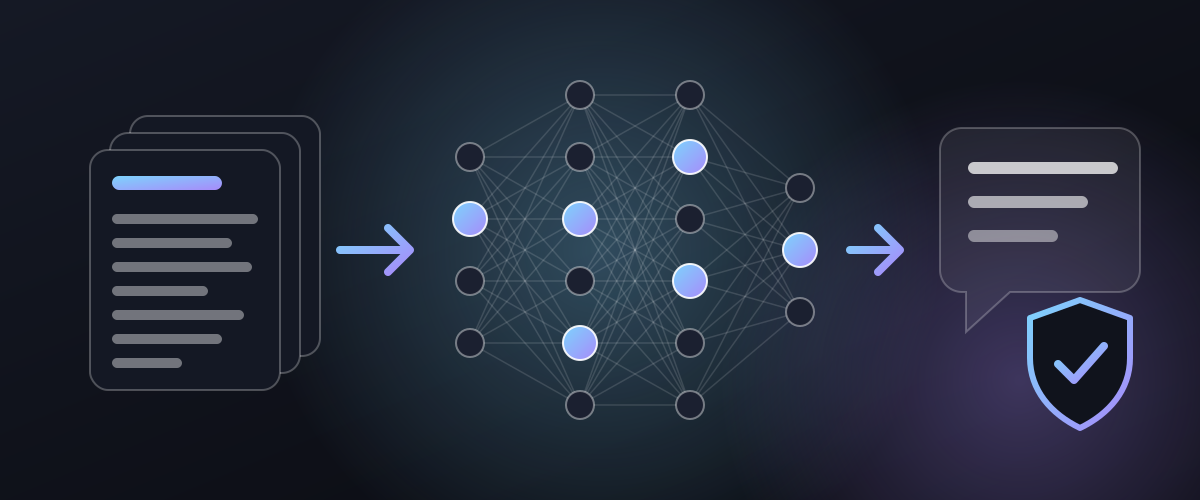
- A way of building software loosely inspired by the brain: layers of simple connected units that together learn complicated patterns.
- Deep learning
- Machine learning that uses neural networks with many layers. It is behind almost all recent progress in AI.
- Model
- The trained system itself: the thing that takes your question and produces an answer. GPT, Claude and Gemini are families of models.
- Generative AI
- AI that creates new content, such as text, images, audio, video or code, rather than only sorting or analysing what exists.
- Large language model (LLM)
- A model trained on huge amounts of text to predict what comes next. It is the engine inside chatbots such as ChatGPT and Claude.
- Chatbot
- A program you talk to in ordinary language. Modern chatbots are an LLM with a chat window on top.
- Algorithm
- A set of steps a computer follows. In everyday talk it often means the system that decides what you see on social media.
- Foundation model
- A large general-purpose model that other products are built on, by many different companies.
Using AI
- Prompt
- What you type or say to an AI. Clearer, more detailed prompts get better answers.
- Prompt engineering
- The skill of writing prompts that reliably get good results. Less mysterious than it sounds: mostly being clear and specific.
- System prompt
- Hidden instructions given to the AI before your conversation starts, setting its role, tone and limits.
- Context window
- How much text a model can take in at once, including your conversation so far. Go beyond it and the earliest parts are forgotten.
- Token
- The small piece of text a model reads and writes, about three-quarters of a word. Limits and prices are measured in tokens.
- Hallucination
- When an AI states something false as if it were fact, such as an invented quotation or a source that does not exist.
- Multimodal
- Able to work with more than one kind of input or output: text, images, audio and video.
- Reasoning model
- A model that works through a problem step by step before answering. Slower, but better at maths, logic and planning.
- Agent
- An AI that does not just answer but carries out a task in several steps, using tools such as a web browser or your files.
- Tool use
- A model's ability to call on other software, such as a search engine, a calculator or your calendar, to get something done.
- Vibe coding
- Building software by describing what you want in plain language and letting an AI write the code.
- Custom instructions
- Standing preferences you give a chatbot once, such as your job or the style you like, which it applies to every chat.
How it is built
- Training
- The process of showing a model vast amounts of data and adjusting it, over and over, until it performs well.
- Training data
- The text, images and other material a model learns from.
- Parameters
- The billions of adjustable numbers inside a model where what it has learned is stored. Also called weights.
- Transformer
- The design, published by Google researchers in 2017, that almost all modern language models are built on. It is the T in GPT.
- Pre-training
- The first and largest stage of training, in which the model learns general knowledge by predicting text.
- Fine-tuning
- Further training on a smaller, specific set of examples to make a model better at a particular job or style.
- Reinforcement learning
- Learning by trial and error, with rewards for good results. It is how AlphaGo learned to play Go.
- Inference
- Using a trained model to produce an answer. Every question you ask is an inference.
- Compute
- Computing power. The amount available is one of the main limits on how capable a model can be.
- GPU
- Graphics processing unit: the type of chip, mostly made by Nvidia, that AI models are trained and run on.
- Data centre
- A building full of computers. The largest AI data centres use as much electricity as a city.
- Open-source or open-weight model
- A model whose parameters are published so anyone can download, run and adapt it. Meta's Llama is an example.
- Benchmark
- A standard test used to compare models. Useful, but models can be tuned to do well on them.
- Knowledge cut-off
- The date a model's training data ends. It knows nothing after that unless it can search the web.
Getting better answers from your own information
- RAG (retrieval-augmented generation)
- Giving a model relevant documents to read before it answers, so the reply is based on your information and not only on its training.
- Embedding
- A way of turning text into numbers so that a computer can find passages with a similar meaning, not just the same words.
- Grounding
- Tying an AI's answer to checkable sources, such as search results or your own files, to cut down on hallucinations.
- API
- A way for one program to talk to another. Businesses use a model's API to build it into their own products.
Safety and the big picture
- Guardrails
- The rules, filters and training that stop an AI producing harmful or unwanted content.
- Jailbreak
- A trick prompt that gets an AI to ignore its safety rules.
- Prompt injection
- Hidden instructions planted in a web page, email or document to hijack an AI that reads it. A real risk for agents.
- Alignment
- The problem of making sure an AI system pursues the goals its makers and users actually intend.
- Red teaming
- Deliberately attacking a system before release to find its weaknesses.
- Bias
- Unfair patterns in an AI's output, usually inherited from its training data.
- Deepfake
- A fake but realistic image, video or voice recording of a real person, made with AI.
- AGI (artificial general intelligence)
- AI that can do most intellectual work as well as a capable person. There is no agreed definition or test.
- Superintelligence
- A hypothetical AI far more capable than any human in almost every field.
- Recursive self-improvement (RSI)
- AI helping to build better AI, which then builds better AI still, in an accelerating loop.